How to Search and Summarize PDFs: One, Many, Scanned (2026)
How to search PDF files (one, many, and scanned with OCR), extract their text, summarize them with a prompt that works, verify the result, and make them readable by your own AI.
On this page
- Why finding information in PDFs is harder than it looks
- Mastering search within a single PDF
- Use basic Find first
- Use Advanced Search when the document is dense
- Searching across many PDFs at once
- Desktop search versus dedicated PDF tools
- Prepare files before you search them
- The scanned PDF problem, and how OCR fixes most of it
- Why scanned PDFs fail normal search
- Extracting text from a PDF
- When OCR isn't enough
- Advanced and command-line search techniques
- When command-line search makes sense
- The power of regex
- Summarizing a PDF once you can search it
- Pick the method before you summarize
- Prepare the file
- Prompt for the summary you actually need
- Verify against the source
- Privacy before you upload
- The bigger workflow: PDFs your own AI can search
- What Sensefold does with a PDF
- Frequently asked questions
- How do I search for text inside a single PDF?
- Why can't I search a scanned PDF?
- How do I search across many PDFs at once?
- What's the fastest way to search a scanned contract or handout?
- How do I extract text from a PDF?
- How do I summarize a PDF for free?
- How do I summarize a scanned PDF?
- How do I summarize a very long PDF?
- Can ChatGPT or Claude search and summarize my own PDFs?
- Is my PDF private if I upload it to an AI search or summary tool?
- Bringing it together
You know the file is there. You remember the line. You may even remember the page layout. But when you search the PDF, nothing shows up — so you try another folder, another app, another copy with "final" in the name, and half an hour disappears.
To search PDF files reliably, drop one assumption: that every PDF behaves the same way. They don't. A digitally exported report has a clean text layer and answers Ctrl+F instantly. A scanned handout is just page images — there is no text to find until OCR converts it. And a real library mixes both, plus email attachments, vendor packets, screenshots saved as PDFs, and years of files spread across local and cloud storage. The method that works on one fails on the next.
This is the PDF pillar of our guides. It walks the full range: searching inside a single PDF, sweeping across many at once, fixing scanned files with OCR, extracting text for reuse, command-line and regex techniques for repeatable work, then summarizing a PDF once its text is reachable, and what to do when the document library outgrows file-by-file search entirely. Saving a PDF so you can find it again next month is a filing problem rather than a search problem; how to bookmark a PDF covers that side.
Why finding information in PDFs is harder than it looks
PDF search fails for three concrete reasons: the file has no text layer, the tool hides the controls you need, or the answer is phrased differently than your query. Once a library grows past a few dozen mixed files, those failures compound — and the job stops being "find text in a PDF" and becomes "recall the right passage from a library assembled by different people, in different formats, over time."
You open a lease you reviewed last month, search the exact clause you remember, and get zero results. Then the same phrase fails in a scanned invoice and a downloaded report. Same symptom, different cause. Some files contain a real text layer, so search works. Some are page images in a PDF wrapper — nothing is searchable until OCR runs. And even after OCR, recall stays poor when the text layer is noisy, the wording is inconsistent, or the result is buried across hundreds of similar documents.
Practical rule: if you're opening files one by one to search them, your system is already failing you.
The usual failure points are predictable:
- Wrong file assumption: the PDF looks normal but has no usable text layer.
- Wrong tool: a browser viewer or lightweight preview app hides the search controls you need.
- Wrong target: the answer may live in metadata, file names, or OCR output — not the visible page text.
- Wrong system: folders and memory do not scale once the library gets large.
The trade-off is simple. Basic PDF search is fast and good enough for clean, text-based files. It is weak at cross-document recall, weak with scans, and weak with mixed-format libraries. OCR fixes part of the problem. Indexing fixes another part. Keeping the extracted text, a summary, and the document's context together in one place that your own AI can also read — more on that at the end — fixes the recall problem.
Mastering search within a single PDF
For one open document, start with the simplest tool: Find (Ctrl+F on Windows, Cmd+F on Mac). It works in Adobe Acrobat, every major browser, Preview, and most third-party readers. Switch to Advanced Search only when Find gets noisy.
Use basic Find first
Basic Find is the fastest option when you know the exact term — but use it deliberately:
- Search the shortest distinctive phrase: a long sentence often fails because of line breaks, OCR noise, or punctuation.
- Try variants: search both the formal term and the plain-language version. If "budget forecast" fails, try "forecast," "appropriation," or "financial plan."
- Use single words strategically: search the least common word in the phrase first, then jump between hits.
- Check whether the PDF is text-searchable: if you can't highlight text naturally, the problem isn't your keyword — the file needs OCR.
Use Advanced Search when the document is dense
When the document is long or the term is common, basic Find gets clumsy. Adobe Acrobat Pro's Advanced Search (Shift+Ctrl+F) gives you a structured results panel, exact-phrase and whole-word matching, and the ability to search across a folder of PDFs in one pass. One documented limitation: Acrobat does not include encrypted PDFs in a multiple-document search unless you open those files individually first (Adobe's guide to searching PDFs).
Use the advanced options when any of these apply:
| Situation | Better move |
|---|---|
| Common term with too many hits | Search the exact phrase or combine terms |
| Similar words causing noise | Match whole words where available |
| Notes and annotations matter | Include comments and bookmarks in the search |
| You need document-level context | Review the results panel instead of stepping one hit at a time |
The rule for single-document work: use basic Find for speed, and switch to Advanced Search the moment the first search feels sloppy or incomplete.
Searching across many PDFs at once
To search multiple PDFs, you have three tiers: OS search (Windows Search, Spotlight) finds likely files fast but is unreliable for exact passages; a browser viewer searches one open file; and Adobe Acrobat searches every PDF in a chosen folder and returns hits per document. None of them search by meaning — they all match literal strings against whatever text layer exists.
Desktop search versus dedicated PDF tools
OS search is fast when you only remember part of a filename, a date range, or a phrase that might appear somewhere. But indexing can miss folders, cloud-sync locations may not be fully local, and some PDFs expose text cleanly to the indexer while others don't. You find the file — but not the exact passage, table cell, or comment that matters.
Dedicated PDF software handles that better. Adobe Acrobat can search a folder of PDFs in one pass and return results by document, far better than opening files one by one.
| Tool | Best for | Weak point |
|---|---|---|
| Windows Search or Spotlight | Finding likely files fast | Depends on indexing and folder visibility |
| Browser PDF viewer | Searching one file already open | Bare-bones controls |
| Adobe Acrobat | Searching many PDFs in a chosen folder | Still tied to folder structure and file prep |
That last trade-off matters: folder search beats single-file search, but it still assumes you remember where things live. Once your library spreads across projects, exports, scans, and research dumps, folder-based retrieval starts to feel dated. If the real problem is finding the document again next month rather than a passage inside it, that is a filing problem — see how to bookmark a PDF, which covers internal outlines and saving PDFs where you can retrieve them.
Prepare files before you search them
Multi-file search gets much better when files are named and described well — bad file hygiene is one of the biggest reasons document libraries become slow to work with. Digital.gov's guidance notes that PDF file names are used for query matching and can become the result title when no title tag is set; it recommends hyphens over spaces or underscores, plus a unique title and a plain-language description (Digital.gov's PDF optimization recommendations).
A simple prep standard:
- Rename vague files: replace
scan001.pdfandfinal-v2.pdfwith specific, hyphenated names. - Set the document title: don't let every result show up as a raw filename.
- Add a short description: plain language makes later retrieval easier.
- Store related PDFs together: folder search only works when the folder structure makes sense.
Search quality is often decided when the file is saved.
This helps, but good names and metadata improve retrieval without giving you true cross-document memory. That gap closes only when the text inside the file — not just its name — is indexed in one place.
The scanned PDF problem, and how OCR fixes most of it
If you search a scanned contract for a clause you can plainly see and get zero results, the PDF is an image container — readable to a person, blank to search software. OCR (Optical Character Recognition) converts the page image into a machine-readable text layer, after which you can search, copy, and highlight it like any digital PDF. It fixes the first barrier, but not the whole workflow.
Why scanned PDFs fail normal search
Search inside a PDF depends on a text layer. Digital PDFs already have one; scanned PDFs usually don't, because each page is stored as an image. The fastest test: try selecting a sentence with your cursor. If the whole page behaves like a photo, the file needs OCR. Adobe Acrobat, scanner software, and many document tools can run it.
Extracting text from a PDF
Search and extraction are the same problem seen from two sides: anything that can find text in a PDF can usually get it out. Which route to take depends on the file:
- Text-based PDF, a passage or two: select and copy from any viewer. Watch for line breaks and hyphenation carried over from the page layout.
- Text-based PDF, the whole document: Acrobat's export to plain text or Word, or
pdftotexton the command line (pdftotext -layout report.pdf report.txtkeeps the column layout). - Scanned PDF: run OCR first, then export. Acrobat's "Recognize Text" adds a text layer in place; open-source engines such as Tesseract produce a text file from the page images.
- Tables: export to a spreadsheet-aware format where the tool offers it. Plain-text extraction reads tables in whatever order the page stores the cells, which is often not row by row.
Extracted text is only as good as the text layer underneath it, so the OCR quality checks below apply to extraction just as much as to search.
When OCR isn't enough
OCR can make a file searchable without making it dependable. A scanned PDF can pass OCR and still be brittle to search because the text layer is noisy — the engine misread a character, split a word, or read a dense table in the wrong order. Common culprits:
- Low-resolution scans: weak source images produce weak recognition.
- Dirty originals: crooked pages, copier streaks, stamps, and handwriting confuse OCR.
- Dense layouts: tables, columns, and footnotes get read in the wrong order.
- Difficult typography: old fonts, faded print, and multilingual text reduce accuracy.
- Character substitutions: one bad read ("agreement" → "agreernent") breaks exact-match search for an important term.
When a post-OCR file still won't cooperate, work in this order:
- Verify text selection across multiple pages. Some PDFs are only partially processed — page 3 may be searchable while page 4 is still an image.
- Re-run OCR from the best source you have. A cleaner rescan helps more than tweaking search terms.
- Search for fragments, not perfect phrases. Short stems, nearby names, dates, and section headings survive OCR errors better than long exact phrases.
- Inspect obvious misspellings visually. If a key term matters, scan the surrounding paragraph with your eyes.
- Use a system that retrieves beyond literal matches. Standard viewers are fine for simple lookups; large mixed-format libraries need semantic search that finds meaning, not just exact strings.
That last point is where most workflows stall: OCR clears the first barrier but leaves a fragile text layer spread across scattered folders and old scans. It is also the point where the text becomes usable for something other than search, which is what the summarizing section below picks up.
Advanced and command-line search techniques
For repeatable, large-scale sweeps — hundreds of PDFs for case IDs, invoice formats, or compliance terms every week — a GUI viewer gets tedious. Command-line tools like pdfgrep, pdftotext, and ripgrep are faster for systematic work: they search in batches, slot into scripts, and produce reusable output. The catch: they only work on PDFs that already have a usable text layer. Image-only scans need OCR first.
When command-line search makes sense
Reach for it when you need precision and repeatability:
- Batch keyword sweeps across large folders
- Pattern matching for dates, IDs, emails, and reference numbers
- Automated checks that run on a schedule
- Text-extraction pipelines where PDF content feeds another system
Skip it for casual reading, one-off lookups, or messy archives full of screenshots and poorly named files — cleanup time eats the speed advantage. A common production setup: extract the text, keep page references, index it, then query the index instead of the raw files. It works, but someone has to maintain extraction quality and indexing rules as files change.
The power of regex
Regex is usually the biggest single jump in search quality, because it looks for structure instead of one perfect phrase. Real collections are messy — dates appear in multiple formats, reference numbers gain prefixes, names get abbreviated, OCR introduces small errors. Regex absorbs that:
- Reference hunting: find every file matching a matter-number or contract-ID pattern.
- Contact extraction: pull email addresses or phone-like strings from reports.
- Format drift: catch several wording variations that share one structure.
Even so, command-line search has a ceiling: it's strong at retrieval by string and pattern, weak at recall across mixed formats and scattered sources. Once your archive includes PDFs, notes, highlights, links, and saved web pages, search quality depends as much on system design as on syntax. Good file naming and note-organization habits help, but they don't replace a central place that can search the whole library by meaning.
Summarizing a PDF once you can search it
Finding the passage is half the job. The other half is not reading the whole document: you have a research paper, a board report, a technical manual, or a scanned packet someone emailed without context, and you need the parts that matter, fast. People rarely fail at this because summarizing is impossible. They fail because they pick the wrong method, skip file prep, or ask an AI tool for "a summary" and hope for the best — which usually produces something polished, vague, and not very useful. The reliable version has four parts: pick the method, prepare the file, generate the summary with clear instructions, then verify and reshape it for your actual use.
Pick the method before you summarize
- Manual is still right for short, high-stakes documents — contracts, reviewer comments, policy revisions, anything where wording matters. It's slow, but it preserves nuance and helps you internalize the text. If your next step is to argue from the PDF or make a decision with consequences, manual beats automation.
- Software (OCR utilities, extractive summarizers) sits in the middle. It rarely produces elegant prose, but it's how you turn a scanned or messy PDF into workable text.
- AI is the strongest option for long, text-heavy documents when you want speed plus structure: executive briefs, topic-specific summaries, first-draft notes. The payoff is biggest when the document is too long to read fully but too important to ignore.
| Method | Best for | Speed | Accuracy control | Key benefit |
|---|---|---|---|---|
| Manual | Short, critical documents | Slow | High | Best nuance retention |
| Software | Scanned PDFs, simple extraction | Medium | Medium | Makes inaccessible text usable |
| AI | Long, complex text-based PDFs | Fast | Medium–high with good prompts | Produces structured drafts quickly |
A simple rule: if precision matters most, start manual. If accessibility is the problem, start with software and OCR. If volume is the problem, start with AI — then verify.
Summarize for a purpose, not for completeness. A summary for exam prep, an executive briefing, and a fact-extraction pass are three different outputs. Define which one you want before you upload, or even a strong tool drifts into generic abstraction.
Prepare the file
The file itself decides how clean your summary can be. Plenty of bad summaries start with a PDF the tool never properly read. Run the same preflight as for search: try selecting a sentence, and if you can't, the file needs OCR before any summarizer can do real work. Then watch for the usual blockers — password protection stops some tools from ingesting the file at all, multi-column layouts, footnotes, and sidebars confuse extraction, and huge appendices that don't matter add noise, so drop them from scope.
For very long PDFs, don't paste the whole thing in and ask for one neat answer — that invites omissions. The dependable approach is layered: split by chapter or section, summarize each part, then condense those summaries into a higher-level one, keeping page references or section labels attached as you go. (AWS describes this hierarchical, chunk-then-condense pattern for documents that exceed a model's context window.)
If you save the PDF into Sensefold rather than pasting it into a bare chatbot, most of this prep is automatic: scanned pages are OCR'd on ingest and long documents are split into page-aware chunks, so "preflight" mostly means checking the file fits the limits in Files & media, 10 MB and 200 pages, and that you have credits for its pages.
Prompt for the summary you actually need
"Summarize this PDF" is almost always too vague — the model has to guess the audience, the depth, and what matters. Tell it four things instead:
- Audience: non-expert reader, executive, student, reviewer, legal team
- Objective: understand the argument, extract risks, pull financial details, prep study notes
- Format: bullets, memo, table, paragraph, Q&A
- Scope: the whole PDF, selected pages, only methods and results, only sections mentioning one topic
A stronger prompt sounds like this:
Summarize this PDF for a non-expert audience. Focus on the main claim, supporting evidence, limitations, and real-world implications. Keep it under six bullets and flag anything uncertain.
Different document types reward different asks:
- Research papers: "Extract the research question, method, key findings, limitations, and any stated future work."
- Business reports: "Summarize strategic priorities, risks, financial references, and operational changes."
- Technical manuals: "List setup steps, warnings, prerequisites, and troubleshooting sections in plain English."
- Legal or policy PDFs: "Summarize obligations, exceptions, deadlines, approval requirements, and enforcement language."
The same principle drives format-sensitive summarizing of any source — our guide on how to summarize a YouTube video makes the same point: output improves when you define audience, length, and structure up front. And don't stop at the first acceptable answer. The best summaries come in rounds — a broad pass first, then "rewrite this as an executive brief," then "pull just the caveats and conflicts." The first output shows you what the model noticed; the follow-up corrects what it missed.
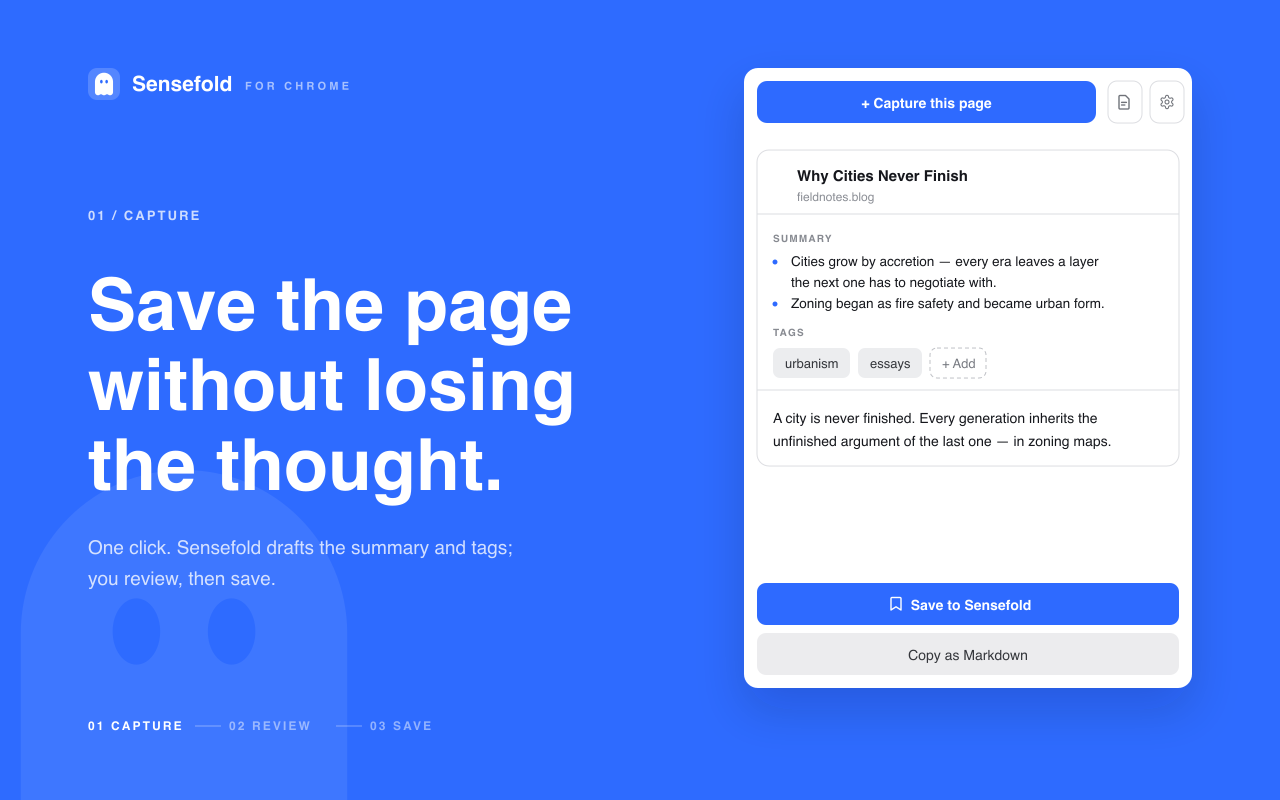
In Sensefold, the first pass is automatic and needs no prompt: save a PDF and it gets a summary, tags, and OCR'd, searchable text — the same automatic summary-and-tags step the extension shows above for a web article. The follow-up rounds happen in whichever AI you already use, which searches your library with search_hub, reads the document with get_item, and then writes the executive brief or the caveats-only extraction you asked for. How that connection works is in the Sensefold section below.
Verify against the source
A usable PDF summary survives contact with the source. If it falls apart the moment you check a table or a conclusion paragraph, it didn't save time — it postponed the reading.
Don't verify every line with equal intensity. Check what would cause a bad decision if it were wrong: figures, dates, named entities, quoted language, recommendations, and any statement that turns a cautious source into a confident takeaway. The more actionable the sentence, the closer it needs to stay to the PDF. A fast review pass catches the common failures:
- Compression errors — the summary drops qualifiers like "may," "under these conditions," or "in this sample."
- Quote drift — the wording looks exact, but the source says something narrower.
- Table and footnote misses — basic summarizers handle body text better than dense tables and notes.
- Missing exceptions — legal, policy, and technical PDFs often put the real constraints after the main argument.
This is where keeping the source attached pays off. If a summary says "the report found…," you want the page number or section title sitting right next to the claim, so checking it is a quick lookup instead of re-searching a 70-page file. For more on why source-attached notes beat free-floating ones, see why your AI's answers should cite your own saved sources.
Privacy before you upload
Ask the question most guides skip: should this file go to a third-party service at all? If the PDF holds personal, financial, legal, medical, or confidential business information, treat summarization as a data-handling decision first. Check data retention, whether uploads train models, whether you can delete files and summaries, and who can see the document. Convenience isn't a privacy policy. A trustworthy tool tells you exactly which services touch your files; Sensefold, for example, publishes its full list of subprocessors, so you can see every vendor in the path — from the parser that reads the PDF to the model that summarizes it — before you upload one.
The bigger workflow: PDFs your own AI can search
You save a PDF on your laptop, highlight a page on your phone, clip a related article a week later — then need all of it in one meeting, or in the middle of a ChatGPT or Claude session. The failure isn't search inside one file; it's that the evidence lives in five places and none of them is reachable by the AI you are actually working in. At that point PDF search becomes a systems problem, and Ctrl+F, folder search, and OCR stop being enough.
The workflow that holds up has three steps: capture the document into one library, let OCR and enrichment run on save, and connect that library to whatever AI you use so it can search the text itself. Done that way, "which folder was that PDF in?" turns into a question your AI can answer from your own material — with a link back to the document.
- Mixed formats live together. PDFs sit beside notes, web clips, videos, and AI conversations instead of being trapped in separate apps.
- Context is added at capture time. Summaries, tags, and extracted OCR text give search more to work with than a filename.
- Search works by meaning. Semantic search finds the right passage even when your wording doesn't match the document's.
- Your AI reads the same library. The same search that works in the app works from an AI client, so an answer can be grounded in the PDF you saved rather than in what the model remembers.
What Sensefold does with a PDF
Sensefold is a personal context: one private, model-independent space where PDFs, articles, videos, threads, and AI conversations are stored as Markdown, enriched with summaries, tags, and OCR on save, and readable and writable by any AI you use over MCP. Saving is free; AI processing runs on credits. Mapped to the workflow above:
- Capture. Save a PDF from the web app (drag-and-drop, paste, or a link to a PDF), from the share sheet on iPhone — a PDF from Mail, Files, or Safari goes straight in instead of being downloaded, renamed, and re-uploaded — or from the macOS app. Supported file types are listed in the files & media guide.
- OCR and page-aware chunking on save. Sensefold extracts the text — running OCR on scanned PDFs and images automatically — and splits it into page-aware chunks with section headings preserved. There is no manual OCR step. It is built for documents and reports, not multi-thousand-page archives.
- Summary and tags on save. Each captured PDF gets a short summary plus tags, generated without a prompt, so you can scan and filter without reopening the file. Your own notes are indexed for search but never rewritten by Sensefold's automatic AI.
- Hybrid search across the library. Keyword and semantic search together — the fix for the noisy-OCR and inconsistent-wording problems that break literal search.
- Your AI searches it over MCP. Connect Claude, ChatGPT, Claude Code, Codex, Cursor, OpenClaw, Hermes, or any MCP client to
https://api.sensefold.app/mcp— paste the URL and authorize with OAuth, or use a revocable Agent key with a read_only, edit, or full tier. Your AI callssearch_hubto find the passage andget_itemto read the document. Every result carries a deep link to the saved item plus the matched pages and the section that matched (heading path and page range), so the AI can read that passage in context and cite the PDF you actually saved, and the link opens the document so you can check the page yourself. Notes it writes back withsave_noteorupdate_noteare versioned and revertible. Setup details are on the for agents page and in the MCP tools reference. - Export. The whole library exports as a Markdown ZIP from the web app, so the extracted text is never locked in.
The payoff is reliability: you stop depending on one exact keyword landing in one exact file, and get multiple paths back to the same source — from the app, from search, and from the AI you already use. Plans and credits are on the pricing page.
Frequently asked questions
How do I search for text inside a single PDF?
Open the file and press Ctrl+F (Windows) or Cmd+F (Mac) to use Find — it works in Acrobat, browsers, and Preview. For long or dense documents, switch to Acrobat Pro's Advanced Search (Shift+Ctrl+F) for whole-word matching, a structured results panel, and folder-wide search.
Why can't I search a scanned PDF?
Because a scanned PDF is usually a set of page images with no text layer, so there's nothing for search to match. Run OCR (Optical Character Recognition) to convert the images into machine-readable text; afterward you can search, copy, and highlight it like any digital PDF. Tools like Sensefold run OCR automatically when you save the file.
How do I search across many PDFs at once?
Use OS search (Spotlight or Windows Search) to surface likely files, or Adobe Acrobat to search every PDF in a chosen folder and return hits per document. For libraries that mix PDFs, notes, images, and web clips, a library that runs OCR on save and searches by meaning retrieves by content instead of folder location.
What's the fastest way to search a scanned contract or handout?
Test whether it has a text layer by trying to select a sentence. If the page acts like a photo, run OCR first, then search short fragments — names, dates, section headings — rather than long exact phrases, since those survive OCR errors better.
How do I extract text from a PDF?
For a text-based PDF, copy from the viewer or export to text or Word; pdftotext does the same in bulk from the command line. For a scanned PDF, run OCR first (Acrobat's Recognize Text, or an engine such as Tesseract), then export. Tables need a spreadsheet-aware export, because plain text loses the row order.
How do I summarize a PDF for free?
For a text-based PDF, a free AI chatbot or a built-in browser tool can produce a usable brief — paste or upload the file and give it a specific prompt (audience, objective, format). Watch two things: free tools often cap file size or page count, and "free" usually means your document is processed on someone else's servers, so it's a poor fit for anything confidential.
How do I summarize a scanned PDF?
A scanned PDF is really a stack of images, so a summarizer sees nothing until the text is recognized. Run OCR first — Sensefold does this automatically when you save the file. If your tool doesn't, OCR the file with a dedicated utility, then summarize the resulting text.
How do I summarize a very long PDF?
Don't paste 100+ pages in and ask for one answer — you'll get omissions. Summarize in layers: break the document into sections, summarize each, then condense those into a top-level brief, keeping page or section labels attached. And check your tool's limits up front; most have a page or file-size ceiling, so a 500-page report may need splitting regardless.
Can ChatGPT or Claude search and summarize my own PDFs?
Yes, if the PDFs live in a library the AI can reach. With Sensefold, saved PDFs are OCR'd and indexed, and any MCP client — Claude, ChatGPT, Claude Code, Cursor and others — connects to https://api.sensefold.app/mcp, searches them with search_hub, and reads the matching document with get_item before writing the brief you asked for. Results link back to the saved document. See the for agents page.
Is my PDF private if I upload it to an AI search or summary tool?
That depends on the tool, so check its disclosures. Sensefold publishes its full list of subprocessors — including the services it uses for PDF extraction and enrichment, LlamaParse and Gemini — on its subprocessors page, and its privacy policy covers retention and training, so you can see exactly which third parties touch your files before you upload.
Bringing it together
PDF search isn't one skill — it's a ladder. Ctrl+F handles a single clean document; Advanced Search and folder search handle a few dozen; OCR rescues scans; and command-line tools with regex handle systematic, repeatable sweeps. Summarizing sits on top of that ladder: it only works once the text is reachable, and it only saves time when you prompt for a purpose and verify the result against the page. But every rung still searches literal strings against whatever text layer exists, which is why mixed, scattered libraries eventually outgrow it.
When your PDFs, notes, screenshots, and saved research live in too many places, capture them into one library, let OCR run on save, and connect that library to the AI you already use. Sensefold does exactly that: automatic OCR, summaries, and tags on every saved PDF, hybrid search across the library, and MCP access for your own AI — built so the thing you read once is the thing you, and your AI, can find again. If the problem is saving a PDF so it stays findable in the first place, how to bookmark a PDF picks up where this one stops.